The Anxiety Trap: Why Control Backfires

Photo by Joice Kelly on Unsplash
Imagine telling someone: "Whatever you do, don't think about a pink elephant." What's the first thing they’ll think about? That's right, a pink elephant. This trap lies at the heart of anxiety: the harder we try to control or avoid our anxiety, the more powerfully it grips us. While our anxiety presents itself as a problem to be solved, our attempts to eliminate it often become the very fuel that keeps it burning. A cruel irony. This effect fundamentally challenges our natural instincts about how to handle stress and worry, creating a vicious cycle that can feel impossible to escape.
What Is Anxiety? Understanding the Disorder
Before we dive into this paradox, let's establish a clear picture of what we're dealing with. Anxiety isn't just an inconvenience—it's a complex emotional and physiological response that has been essential to human survival. Like an internal alarm system, anxiety alerts us to potential threats and prepares us for action. Anxiety becomes a disorder when it significantly interferes with daily life, work, school, or relationships.
Anxiety disorders manifests in several distinct forms, each with its own characteristics:
Generalized anxiety disorder
Panic disorder
Social anxiety disorder
Phobia-specific disorders (e.g., fear of heights, dogs, etc.)
These variations share common symptoms that most people will recognize:
Nervousness and irritability
Fatigue
Catastrophic thinking (i.e. ‘what if?’ scenarios)
Excessive worry
Psychosomatic symptoms (e.g., headaches, muscle tension, stomach issues)
How the Anxiety Cycle Begins
When anxiety strikes, our natural response is to try to eliminate it. We might avoid triggering situations, seek constant reassurance, or try to control every aspect of our environment. These strategies seem logical—after all, if something causes distress, shouldn't we try to get rid of it? Yet this very attempt at control often becomes the foundation of a self-reinforcing cycle.
The Anxiety Trap in Action
To understand how this paradox plays out in real life, consider these common scenarios:
Imagine you're afraid of flying and have an upcoming trip. As the date approaches, you might obsessively check weather reports, research plane safety statistics, or consider canceling your flight. While these actions stem from a desire to feel more in control, they often amplify your fear and reinforce your anxiety about flying.
A person with social anxiety might avoid gatherings to prevent discomfort. However, this avoidance can intensify their fear over time by preventing them from learning that social situations can be manageable and even enjoyable.
Someone with panic disorder might carry "safety" items everywhere, like medication or water, believing these will prevent a panic attack. This reliance often increases their anxiety about being without these items, paradoxically heightening their overall anxiety.
The Science Behind the Anxiety Trap
When we encounter a perceived threat, our amygdala – the brain's fear center – activates our stress (fight-or-flight) response. This evolutionary mechanism is designed to protect us from danger. However, in cases of anxiety, this system can become overactive, responding to non-threatening situations as if they were genuinely dangerous. I often encourage my clients to think of their anxiety response like a light switch. Normally, this switch flips on when there's danger and off when things are safe. But sometimes, especially after traumatic experiences, it's like the switch gets jammed in the 'on' position. So the alarm keeps blaring, even when there’s no real threat.
This mechanism operates through three key processes:
First, there's the role of avoidance and negative reinforcement. When we avoid anxiety-inducing situations, we experience immediate, short-term relief. Our brain interprets this relief as a reward and solution, which strengthens our tendency to avoid similar situations in the future.
Second, this avoidance prevents crucial learning opportunities. By consistently avoiding feared situations, we never give ourselves the chance to discover that we can handle them effectively.
Finally, avoidance leads to sensitization—our anxiety response becomes increasingly sensitive over time—leading us to perceive more situations as threatening, even when they’re not. This creates a painful anxiety and avoidance cycle, preventing us from learning to regulate our anxiety effectively.
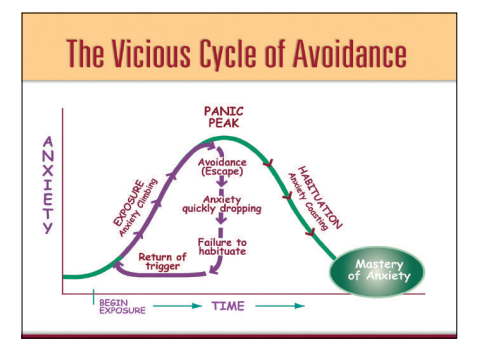
Diagram showing the vicious cycle of anxiety & avoidance.
Anxiety Treatment Approaches That Work
Breaking the anxiety cycle involves embracing approaches that may seem counterintuitive at first:
Exposure Therapy: This approach gradually confronts feared situations instead of avoiding them in a systematic way to allow the brain to learn that these situations are manageable.
Mindfulness and Acceptance-Based Strategies: These techniques encourage observing anxious thoughts without trying to judge, control, or eliminate them.
Cognitive-Behavioral Techniques: These methods help reframe anxiety-inducing situations more realistically through challenging distorted thought patterns or belief systems.
These approaches aim to change our relationship with anxiety rather than attempting to eliminate it entirely (which is unrealistic!) often leading to more sustainable relief and improved quality of life.
When to Seek Therapy for Anxiety
It’s normal to experience occasional anxiety; however, if your anxiety is persistent or intense in its presentation, and it interferes with your daily functioning — it may be helpful to seek professional help. Consider reaching out to a therapist if you're experiencing:
Excessive worry that feels difficult to control and persists for weeks or months
Physical symptoms like chronic tension, headaches, or digestive issues that your doctor has ruled out as medical conditions
Avoidant behaviors that limit your work, relationships, or activities you once enjoyed
Sleep disturbances caused by racing thoughts or worry
Impact on relationships where anxiety creates conflict or isolation
As a Licensed Clinical Social Worker serving adults in California, Colorado, and Texas, I've worked with many clients who have experienced debilitating anxiety. Therapy for anxiety, particularly evidence-based approaches like Cognitive-Behavioral Therapy (CBT) and exposure therapy, can provide you with practical tools to break the anxiety and avoidance cycle, and reclaim your life.
If you're ready to develop a healthier relationship with anxiety, I invite you to reach out for a phone consultation by emailing me: noemi@stillnesstherapy.net. I will help you develop personalized treatment goals that addresses your specific concerns.
Closing Thoughts on Managing Anxiety
The anxiety trap illuminates a crucial truth about managing anxiety: our natural instinct to control or eliminate anxious feelings often backfires, creating the very distress we seek to avoid. This understanding transforms how we approach anxiety management. Rather than falling into the paradoxical trap of trying to control our anxiety, which only tightens its grip, we can learn to respond differently.
Remember, the goal isn't to eliminate anxiety (our alert system), which is a normal and useful emotion, but to develop a healthier relationship with it. By learning to navigate anxiety rather than trying to control it, we can lead fuller, more balanced lives.
Stay tuned for my upcoming post on managing holiday anxiety, where I’ll explore how these concepts apply to the unique stresses of the holiday season.